AI Compliance Checklist for Startups
Startups building or using AI systems often assume compliance is something to worry about later. That is a mistake. The EU AI Act creates obligations around risk classification, documentation, governance, and internal oversight, and startups that prepare early will be in a much stronger position than those that wait until customers or investors ask questions.
This practical guide explains what a startup-level AI compliance checklist should include and how smaller companies can begin preparing without hiring an expensive consulting firm.
Why startups need an AI compliance checklist
Even if your company is small, you may still need to document how AI systems are used, who owns them internally, what risks they create, and what safeguards are in place. A checklist helps startups avoid scattered documentation and makes compliance preparation more manageable.
It also creates a stronger internal process for:
- mapping AI systems used in the business
- identifying potential high-risk use cases
- assigning internal responsibilities
- tracking documentation requirements
- preparing for customer, investor, or regulatory questions
AI compliance checklist for startups
1. Create an inventory of AI systems
Start by listing every AI system your company builds, integrates, or relies on. This includes internal tools, customer-facing AI features, external APIs, and third-party AI services.
2. Record system owners
Each AI system should have a clear internal owner. This may be a product lead, engineering manager, compliance lead, or CTO. Someone must be accountable for updates, documentation, and governance.
3. Define the use case
Document what the AI system is actually used for. This should be written in plain language, not vague technical jargon. The use case is critical for later risk classification.
4. Assess whether the system could fall into a higher-risk category
Not all AI systems create the same regulatory burden. Startups should review whether a system is being used in a context that could trigger more serious obligations under the EU AI Act.
5. Track documentation requirements
For each AI system, record what documentation exists and what is missing. This may include technical information, intended purpose, oversight measures, data sources, or testing records.
6. Assign governance responsibilities
Compliance is not just a legal task. A startup should identify who is responsible for governance, documentation review, system monitoring, and policy decisions.
7. Review human oversight measures
If a system influences decisions or outputs that matter to users, customers, or employees, the business should record what human oversight exists and when people can intervene.
8. Review data and privacy implications
AI governance should also connect with data protection obligations. Startups should review whether personal data is involved and whether privacy, transparency, or access controls need attention.
9. Build a repeatable internal review process
A checklist is not useful if it is reviewed once and forgotten. Startups should establish a recurring compliance review process, especially when launching new AI features or adding new vendors.
10. Monitor readiness across the business
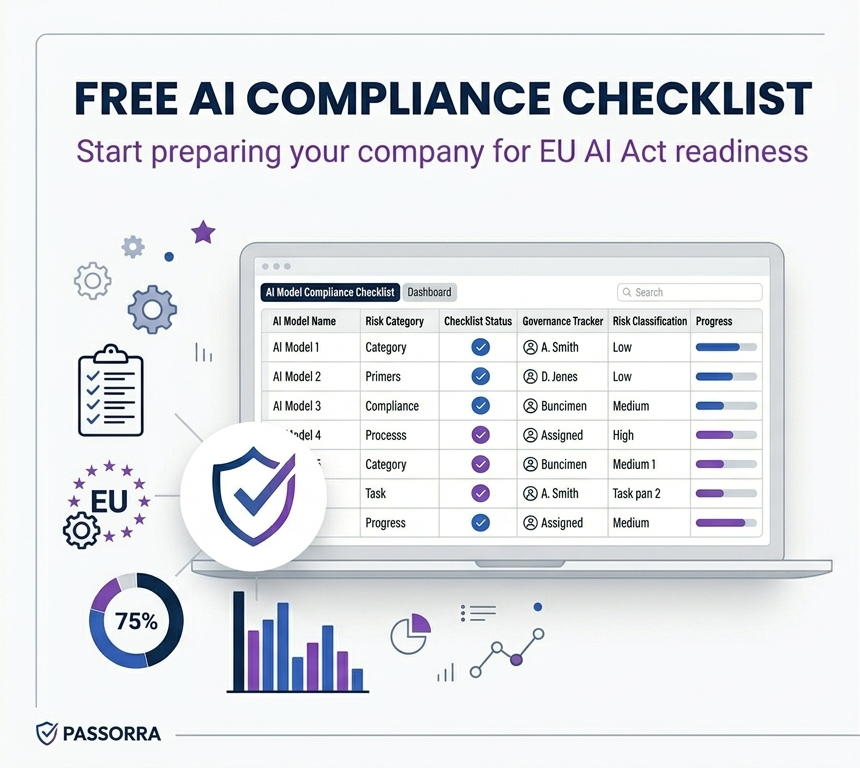
Use a tracker or dashboard to see which systems are documented, which are still under review, and which need action. This turns compliance from a vague concern into a manageable operating process.
Need a practical AI compliance system?
The PASSORRA AI Compliance Toolkit helps startups and SMEs document AI systems, classify risks, and organize governance work in one place.
Common startup mistake: treating compliance as a future problem
Many founders wait until enterprise customers ask for compliance information. By that point, the team is usually rushing to reconstruct information that should have been documented from the start. A simple checklist avoids this problem and reduces later operational stress.
Final thoughts
An AI compliance checklist for startups does not need to be complicated. What matters is having a structured way to inventory AI systems, classify risk, track documentation, and assign ownership internally. Start small, keep it practical, and build a repeatable governance process.
You can read EU AI Act risk classification explained
You can also read How to Create an AI System Register
Disclaimer: This article is for informational purposes only and does not constitute legal advice.
Start Preparing for AI Act Compliance Today
Download the PASSORRA AI Compliance Toolkit and begin structuring your AI governance documentation today.
Get the Toolkit