EU AI Act Risk Classification Explained for SMEs
Published by Passorra
One of the most important concepts in the EU AI Act is risk classification. The regulation does not treat every AI system the same. Instead, it applies different obligations depending on the type of risk an AI system creates.

For startups and SMEs, this is a critical point. Before you can organize documentation, assign responsibilities, or prepare internal controls, you need a structured way to assess what kind of AI systems you are using and how those systems may be viewed under the regulation.
This guide explains EU AI Act risk classification in practical terms so smaller organizations can begin structuring their compliance work with more clarity.
What Is Risk Classification Under the EU AI Act?
The EU AI Act uses a risk-based framework. AI systems are grouped into categories based on the type of harm or regulatory concern they may create.
In simple terms, the higher the regulatory risk, the more compliance obligations apply.
The four broad categories typically discussed are:
- prohibited AI practices
- high-risk AI systems
- limited-risk AI systems
- minimal-risk AI systems
For SMEs, the goal is not to become legal experts overnight. The goal is to create an internal process for reviewing systems consistently and documenting the reasoning behind the classification.
Why Risk Classification Matters for SMEs
Many smaller organizations assume the EU AI Act only matters for large technology companies. That is a mistake.
If your company develops AI-enabled products, integrates AI into services, or uses AI systems in sensitive workflows, classification matters because it determines what kind of documentation, controls, and governance work may be needed.
Without a classification workflow, teams end up making ad hoc decisions with no written record. That creates confusion later when customers, auditors, legal advisors, or internal stakeholders ask how a system was assessed.
The Four Main Risk Levels Explained
1. Prohibited AI Practices
These are AI uses that are considered unacceptable under the regulatory framework. They are treated as creating risks that should not be allowed.
SMEs should pay attention here because even if a company is not building sophisticated models, it may still adopt tools or workflows that create prohibited-use concerns if the use case crosses important legal boundaries.
The practical takeaway is simple: if a use case seems highly intrusive, manipulative, exploitative, or incompatible with fundamental rights, it should be escalated for deeper review immediately.
2. High-Risk AI Systems
High-risk systems are the category most businesses worry about. These are systems that may affect important decisions, rights, opportunities, or safety outcomes.
SMEs should review carefully whether their AI tools are used in areas such as:
- employment and hiring
- education or access decisions
- critical infrastructure contexts
- identity or biometric-related workflows
- essential service access or similar high-impact decisions
If an AI system plays a meaningful role in these kinds of contexts, it may require much more formal documentation and governance attention.
3. Limited-Risk AI Systems
Limited-risk systems generally face lighter obligations, often focused on transparency or disclosure.
These may include systems where users should be aware they are interacting with AI or where the AI-generated nature of content should be clearly communicated.
For SMEs, this category is still important because transparency controls are often easier to implement early if they are captured in your governance tracker from the start.
4. Minimal-Risk AI Systems
Many AI uses will fall into lower-risk categories where the formal regulatory burden is lighter. But lower risk does not mean no governance.
Even if a system appears to be low risk, organizations should still record what it does, who owns it, and why it was assessed that way.
How SMEs Should Approach Classification in Practice
The best way to approach risk classification is through a repeatable internal workflow.
A practical workflow usually includes:
- listing all AI systems in an internal register
- documenting the purpose and use case of each system
- identifying whether the system affects individuals or key decisions
- reviewing whether the system touches sensitive or regulated contexts
- recording a provisional risk assessment
- noting whether escalation or legal review is needed
If you have not yet built the first step, read our guide on how to create an AI system register.
Questions to Ask During Classification
SMEs do not need a perfect legal memo for every system at the beginning. But they should ask structured questions.
- What is this AI system used for?
- Who is affected by its outputs?
- Does it influence decisions involving individuals?
- Does it operate in a high-impact or sensitive context?
- Is there human oversight in the process?
- Do we have enough documentation to support our assessment?
These questions help teams move from vague discussion to documented governance.
Common Mistakes in Risk Classification
- assuming all AI systems are low risk without review
- classifying based only on the technology rather than the real use case
- ignoring third-party AI tools used by internal teams
- failing to record the reasoning behind a classification decision
- not updating the classification when the system’s use changes
For SMEs, the biggest mistake is usually lack of documentation, not lack of effort.
How Passorra Helps
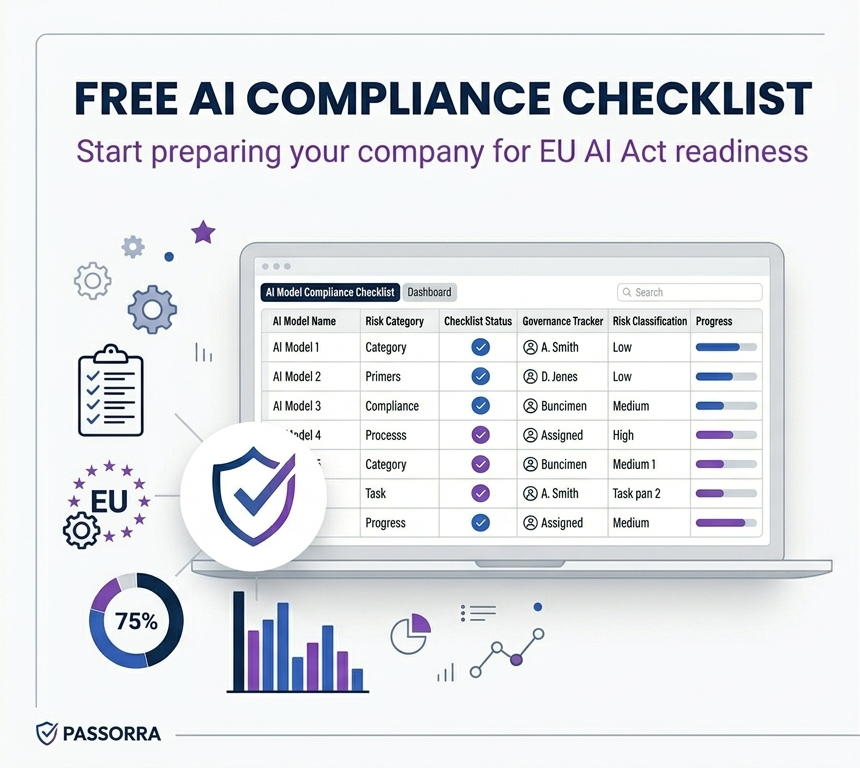
The Passorra AI Compliance Toolkit helps startups and SMEs structure AI governance work through organized registers, trackers, and compliance workflows.
Instead of trying to build classification sheets and tracking logic from scratch, teams can use a practical framework to document AI systems, monitor review status, and organize internal compliance preparation.
If you are starting your compliance journey, you may also want to read our EU AI Act Compliance Checklist for SMEs.
Final Thoughts
EU AI Act risk classification is the foundation of practical AI compliance work. Once your organization understands what systems it uses and what level of risk they may present, the rest of the compliance process becomes far easier to organize.
For most SMEs, the right goal is not perfection on day one. It is building a documented, repeatable process that can improve over time.
You can read EU AI Act Compliance Checklist
You can also read How to Create an AI System Register
If you want a structured starting point, explore the Passorra AI Compliance Toolkit.