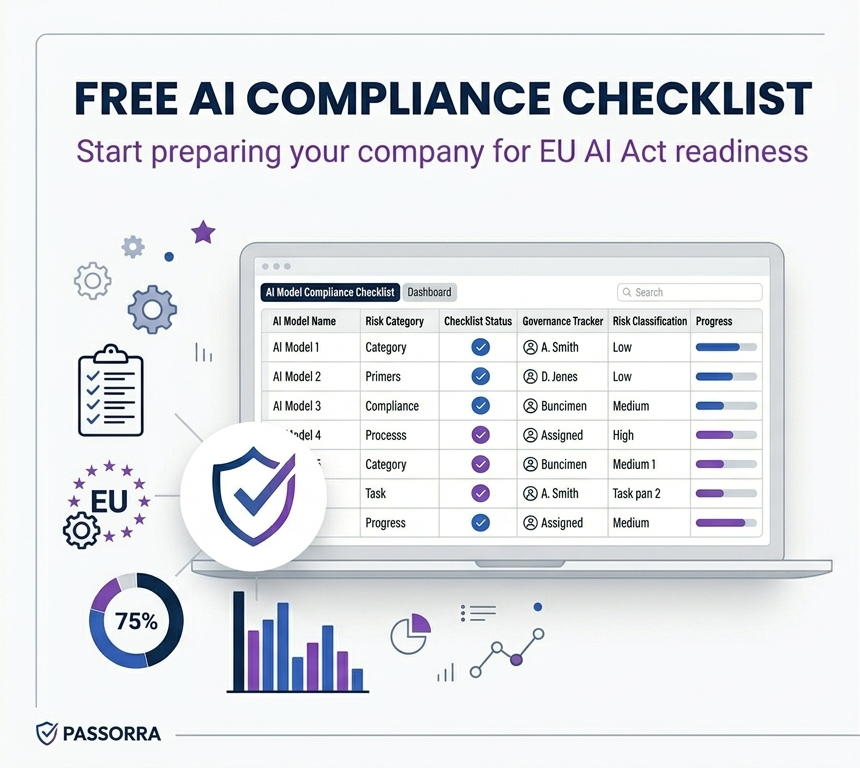
How to Create an AI System Register for EU AI Act Compliance
Published by Passorra
Organizations preparing for the EU AI Act quickly discover that the first step toward compliance is understanding what AI systems they actually use. Many companies operate multiple AI tools across different departments without a centralized inventory.
An AI system register solves this problem. It acts as a structured record of all AI systems used or developed by an organization and forms the foundation for risk classification, documentation tracking, and governance oversight.
For SMEs and startups, creating an AI system register is often the simplest and most practical way to begin organizing EU AI Act compliance efforts.
An AI system register is a centralized inventory that documents every artificial intelligence system used within an organization.
Instead of scattered documentation across teams, the register creates a single source of truth that compliance teams, product managers, and leadership can reference.
It helps organizations answer basic but critical questions:
The EU AI Act introduces a risk-based regulatory framework for artificial intelligence systems. Organizations must determine whether their systems fall into prohibited, high-risk, limited-risk, or minimal-risk categories.
Without a system register, performing this classification becomes difficult because organizations may not even have a complete view of the AI tools currently operating across departments.
A register provides the baseline needed to begin structured compliance work.
A practical AI register should capture several core attributes about each system.
Record the name of the AI system or tool being used. This may be a product name, internal system identifier, or vendor platform.
Document why the system exists and what function it performs within the organization.
Examples include:
Each system should have a clear internal owner responsible for documentation and oversight.
Typical owners include product managers, engineering leads, operations managers, or compliance contacts.
Recording the department helps organizations understand where AI is being deployed and which teams may require compliance training or governance oversight.
Identify whether the system is developed internally or provided by an external vendor.
Third-party AI tools often introduce additional considerations such as vendor transparency and dependency risks.
Beyond the basic fields, organizations often expand their AI registers with additional governance details.
These fields help transform the register from a simple inventory into a governance dashboard.
When organizations first attempt to create an AI register, several challenges typically appear.
Because of this, the register should not be treated as a one-time document. It should evolve as the organization adopts new AI capabilities.
The Passorra AI Compliance Toolkit includes structured templates that help organizations create and maintain an AI system register without starting from scratch.
Instead of manually designing spreadsheets, teams can use a structured framework that organizes AI inventories, documentation tracking, and compliance progress in a single place.
For startups and SMEs preparing for EU AI Act readiness, this approach significantly reduces the effort required to begin compliance preparation.
Creating an AI system register is often the most practical first step toward EU AI Act readiness.
Once organizations have a clear view of the AI systems operating within their environment, they can begin classifying risk levels, organizing documentation, and implementing governance controls.
With the right structure in place, compliance preparation becomes far more manageable.
You can read
EU AI Act Compliance Checklist
You can also read EU AI Act Risk Classification Explained
If you want a structured starting point, explore the
Passorra AI Compliance Toolkit.

What Is an AI System Register?
Why the EU AI Act Makes an AI Register Important
Key Information to Include in an AI System Register
System Name
Business Purpose
System Owner
Department Using the System
Internal or Third-Party System
Additional Fields That Improve Governance
Common Challenges SMEs Face
How Passorra Helps Structure AI Registers
Final Thoughts