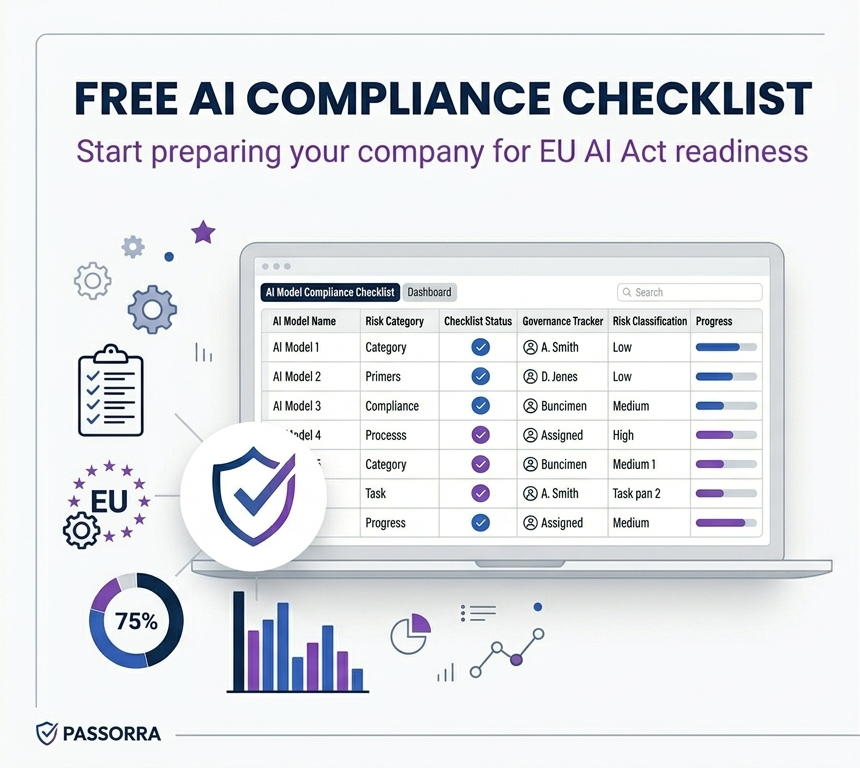
EU AI Act Compliance Checklist for SMEs
Published by Passorra
A practical guide for startups and SMEs that need to begin organizing AI governance, documentation, and risk review under the EU AI Act.

The EU AI Act is changing how organizations approach artificial intelligence governance. For large enterprises, compliance preparation may involve legal teams, consultants, and formal governance programs. For SMEs and startups, the challenge is usually much simpler: where do we begin, and how do we keep everything organized?
That is where a structured compliance framework becomes useful. Before companies think about complex audits or expensive advisory work, they usually need a practical system to track AI systems, document key decisions, organize responsibilities, and monitor progress.
This guide gives you a practical EU AI Act compliance checklist for SMEs so you can begin building that structure internally.
Why SMEs Need a Compliance Checklist
Many small and mid-sized companies are already using AI in internal operations, customer support, content generation, hiring workflows, analytics, or software products. But very few have a clean compliance trail.
In practice, compliance work often gets spread across:
- spreadsheets
- internal notes
- emails
- product documents
- legal drafts
- ad hoc decisions made by different teams
That creates confusion fast. A checklist helps you turn scattered work into a repeatable process.
EU AI Act Compliance Checklist for SMEs
1. Create an inventory of all AI systems
Start by identifying every AI system your business develops, deploys, integrates, or relies on. This should include both internal systems and third-party tools.
Track details such as:
- system name
- business purpose
- team or owner
- vendor or internal origin
- type of outputs produced
- whether the system affects customers, employees, or other individuals
If you do not have a central AI system register yet, your first move should be to create one. You can also read our guide on how to create an AI system register.
2. Map the purpose and use case of each system
It is not enough to know that a team uses AI. You need to understand what the system is actually doing. For example, an AI writing assistant, a CV-screening system, and a fraud-detection model create very different regulatory risk profiles.
Document:
- who uses the system
- what decisions it supports
- whether humans review outputs
- whether individuals are materially affected by its results
3. Classify likely risk level
The EU AI Act follows a risk-based structure. SMEs should establish an internal method for reviewing whether systems appear to fall into prohibited, high-risk, limited-risk, or lower-risk categories.
You do not need to overcomplicate the first version. What matters is creating a repeatable internal assessment workflow. We’ll cover that in more detail in EU AI Act Risk Classification Explained.
4. Identify documentation owners
Compliance fails when everyone assumes someone else is handling it. Assign an owner for each system and each documentation stream.
Typical owners may include:
- product managers
- operations leads
- engineering leads
- legal or compliance contacts
- founders in small teams
5. Start a documentation tracker
SMEs need one place to monitor what documentation exists, what is missing, who owns it, and what still needs review. This is where a structured workbook or compliance tracker becomes valuable.
Your tracker should monitor things like:
- system descriptions
- risk review status
- governance decisions
- human oversight arrangements
- internal review notes
- readiness status
6. Review data and model dependencies
Document what data the system relies on, where that data comes from, and how the system depends on external providers, APIs, or foundation models.
Even if you are not building the underlying model yourself, your organization should understand the operational and governance dependencies involved.
7. Define human oversight points
If AI outputs influence business decisions, document where humans review, validate, override, or escalate system outputs. This is especially important when systems affect employees, customers, or important commercial decisions.
8. Create an AI literacy and awareness record
Teams using AI should not operate in a policy vacuum. Track who uses AI, what internal training or guidance they have received, and what internal rules apply to acceptable use.
9. Establish a simple review cadence
Your AI register and compliance tracker should not be static. Set a review cycle such as monthly or quarterly depending on how often new tools are introduced.
10. Keep evidence organized in one place
The goal is not to create paperwork for its own sake. The goal is to make your compliance work visible, reviewable, and easier to improve over time.
Common Mistakes SMEs Make
- waiting too long before documenting AI usage
- tracking only internally built tools and ignoring third-party AI systems
- treating compliance as only a legal issue rather than an operational issue
- keeping documentation in too many disconnected places
- failing to assign clear ownership
A Practical Starting Point for SMEs
Most SMEs do not need a giant compliance program on day one. They need structure.
A practical starting point usually includes:
- an AI system register
- a risk review workflow
- a documentation tracker
- an internal readiness dashboard
- a simple governance log
That is exactly the type of structure Passorra is designed to support.
How Passorra Helps
Passorra AI Compliance Toolkit is a structured Excel-based toolkit designed for startups and SMEs preparing for EU AI Act compliance work.
It helps you organize:
- AI system inventories
- risk classification workflows
- documentation tracking
- governance records
- compliance progress visibility
Instead of starting from a blank spreadsheet, you can start with a structured framework built for practical internal use.
Final Thoughts
The EU AI Act may feel complex, but the first step for most SMEs is straightforward: identify your systems, organize your documentation, assign ownership, and create a repeatable review process.
You can read EU AI Act risk classification explained
You can also read How to Create an AI System Register
If you want a faster way to do that, explore the Passorra AI Compliance Toolkit.